
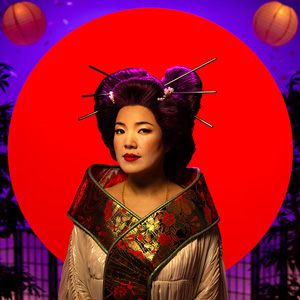
Madama Butterfly at Lyric Opera
At the center of this rethinking is director Matthew Ozawa, Lyric's Chief Artistic Officer and a fourth-generation Japanese American who brings a deeply personal connection to the material. Ozawa's production doesn't attempt to stage a realistic or even a stylized version of Japan. Instead, it leans fully into the idea that what audiences have always been watching is a Western fantasy — Pinkerton's imagined Japan, not the real thing. The production is set within a virtual reality framework that makes that fantasy explicit, filling the stage with endlessly blooming cherry blossoms, stylized nontraditional kimonos, and a Mt. Fuji that looms impossibly from beyond Nagasaki. "The VR setting lets us be literal about the distorted, idealized view of Japan embedded in the opera," Ozawa explains.For those unfamiliar with the story, Madama Butterfly tells the devastating tale of Cio-Cio-San, a fifteen-year-old geisha who falls deeply in love with American naval officer B.F. Pinkerton, only to discover that what she believed was a sacred marriage he regarded as temporary amusement. Abandoned and pregnant, Butterfly waits faithfully for three years, convinced Pinkerton will return. Her unwavering devotion leads to one of opera's most shattering conclusions, set to music of extraordinary beauty — including the iconic aria "Un bel dì, vedremo" and the haunting Humming Chorus.
Ozawa's approach doesn't shy away from the complexities of staging this work today. "Like Butterfly, I have yearned for acceptance but never felt truly at home in any single culture or place," he writes in his director's note. He sees the traditional staging as insufficient for a modern audience. "Producing the opera exactly as it has always been done can do more harm than good," he states. "We have to make room for upholding legacy while allowing for evolution." The music remains largely intact, though Ozawa has incorporated material from Puccini's rarely performed 1904 Brescia version, which offers more dimensional portrayals of the characters. "I didn't want the audience to be lulled into singing along," he explains. "I wanted them to think about what they were seeing."
In a historic first, the production's design team is entirely composed of Japanese and Japanese American women. Set designer dots, costume designer Maiko Matsushima, and lighting designer Yuki Nakase Link — all making their Lyric debuts — bring lived experiences and artistic perspectives to a work that has rarely been shaped by those whose culture it claims to represent. Their involvement has already reshaped the production's emotional landscape. "The women on my team told me they didn't see themselves in Butterfly, especially not in the final scene," Ozawa recalls. "The work has not been a multidimensional vision of who we are." The director hopes this new perspective opens the opera to audiences who may have felt excluded by traditional stagings. "Our hope is that this journey enables our empathy to be open to the impact we have on each other, and the need for a more compassionate understanding of perspectives outside our own," Ozawa writes.
Korean American soprano Karah Son makes her Lyric debut in the title role, bringing a reputation as one of the foremost interpreters of Cio-Cio-San performing today. Son has sung the role at major opera houses around the world, earning acclaim for her ability to capture both Butterfly's youthful innocence and the emotional devastation of her journey, with a voice that delivers the lyric beauty Puccini's melodies demand alongside the dramatic power required for the opera's most wrenching moments.
Joining Son is American tenor Evan LeRoy Johnson, also making his Lyric debut, as the callous Lieutenant B.F. Pinkerton. Johnson brings credits from the Metropolitan Opera, San Francisco Opera, and Houston Grand Opera, with particular praise for his work in the Puccini repertoire. Japanese mezzo-soprano Nozomi Kato, in her Lyric debut as Suzuki, brings both vocal beauty and a deep understanding of the character's cultural context to the role of Butterfly's devoted servant. Baritone Zachary Nelson, a Lyric mainstay since the 2016/17 season with notable turns as Marcello in La Bohème and Ping in Turandot, returns as the compassionate American consul Sharpless.
The cast is rounded out by tenor Rodell Rosel, an alumnus of Lyric's Ryan Opera Center, as the marriage broker Goro; bass Jongwon Han in his Lyric debut as the Bonze; and current Ryan Opera Center ensemble members including baritone Sihao Hu as Prince Yamadori, mezzo-soprano Alexis Peart as Kate Pinkerton, bass-baritone Christopher Humbert, Jr. as the Imperial Commissioner, and baritone Sankara Harouna as the Registrar.
On the podium, Venezuelan conductor Domingo Hindoyan returns to Lyric after his acclaimed debut leading La Bohème in the 2018/19 season. Currently Chief Conductor of the Royal Liverpool Philharmonic Orchestra and the incoming Music Director Designate of LA Opera, Hindoyan has built a reputation for interpretations of Puccini that balance dramatic intensity with orchestral clarity, revealing both the intimate textures and sweeping emotional power of the composer's writing. Chorus Director Michael Black leads the Lyric Opera Chorus through some of Puccini's most memorable vocal passages.
Lyric's Madama Butterfly promises to be one of the essential cultural events in Chicago this spring — a production that honors the music that has moved audiences for generations while insisting that the art form continue to evolve.