
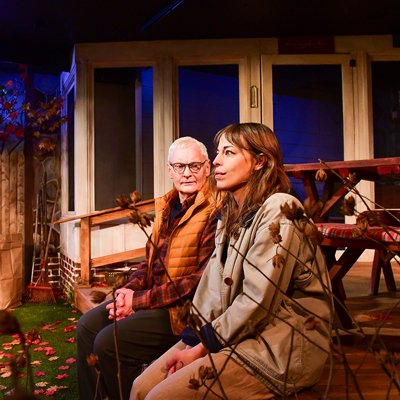
The play is a ninety-minute two-hander with a premise that sounds like nothing. John and his adult daughter Caitlyn are birders. In the backyard of the family home in suburban Maryland, outside Baltimore, they stand with binoculars raised and scan for whatever is passing through. Over the course of the play, roughly a decade goes by. Boyfriends come and go. Jobs change. Losses accumulate. The climate shifts and certain birds stop appearing. Between sightings, the two of them talk, mostly while looking at something other than each other, which is exactly why the conversation flows at all.
John trained as a physician, as did his wife, but he left clinical medicine to spend twenty-five years on vaccine research he never finished, supported by her income. He is a rigorous liberal with an unbending moral compass, so conscientious about his carbon footprint that he has denied himself travel. Caitlyn wanted to be a novelist and instead took whatever work paid, some of it for causes her father finds indefensible. He is disappointed in her, and she knows it, and she is not wrong. She is also not defenseless: her counterargument is that a life of principle was available to him only because he married someone who could fund it, that his ethics are a function of his housing and his retirement account and his wealthy spouse. Neither of them can quite see the other's choices as anything but a failure of character.
What critics kept returning to was how thoroughly the play refuses the easy version of itself. This is familiar territory for a two-hander, and Moench scrambles the expected arrangement immediately by making the father the progressive one and the daughter the compromised pragmatist. Sentimentality never gets a foothold. The dialogue stays conversational even when the stakes are enormous, and the passage of years registers through offhand mentions of a trip or a job rather than through announcement. The most devastating passage in the play belongs to Caitlyn, and rather than building it to a crescendo, Moench keeps it deliberately underplayed, which is exactly why it lands the way it does. Reviewers described the room going completely silent, and, at the end, a lot of people wiping their eyes.
The performances drew admiration without a single dissent. Judd, one of the finest actors in Chicago and a Red Orchid ensemble member, plays John with a dry, laconic charm that conceals the rigidity underneath until the play is well along. It is a portrait of a man with limited access to his own feelings, so certain of himself and so unaware of his own entitlement that he cannot occupy anyone else's view, and Judd keeps him balanced on a knife edge, never letting him tip into either villainy or easy warmth. Critics called it among the best work he has done, which given the length of his résumé is not a small claim. Slaughter-Mason, an Equity Jeff Award winner, was praised most often for the early scenes, where Caitlyn says almost nothing and her face carries an enormous amount of feeling that the audience catches and her father does not. When the play finally gives her room to answer him, she does it like a boxer, and her arc from boisterous young woman to someone gradually softened by disappointment was singled out as the production's quiet engine. Together, the two were described as flawless, deeply felt, and brutally unsentimental.
The design earned a share of the praise usually reserved for the acting. Morgan Laszlo's scenic design reconfigures the theater so that audiences cross a worn deck and pass a screened porch on the way to their seats, arriving in an October backyard where red maple branches lean over a battered picket fence and the last tomatoes hang on yellowing vines. Seojung Jang's lighting holds it all in a soft, failing autumn dusk. Ethan Korvne's original composition and sound design, a blend of woodwind melody and recorded birdsong played through the room's speakers, was described repeatedly as the production's third lead: not a flashy effect but an enveloping one, using the intimacy of the small space to put the audience inside the characters' world rather than in front of it. Ben Argenta Kress designed costumes. In January, several critics noted the specific pleasure of walking in from the cold and finding themselves in early fall.
Fitzgerald's direction was credited with the restraint that makes the rest possible. In lesser hands the material could have gone dull or maudlin, and the staging leans on neither. She keeps the two characters framed rigidly apart, so that any attempt at connection requires physically crossing into the other's territory, and otherwise she gets out of her actors' way and lets the script breathe. The effect is closer to eavesdropping than to watching. Nothing is manipulative. Whatever emotion arrives has been earned.
Birds of North America runs about ninety minutes and includes frank treatment of grief and pregnancy loss. Performances are Thursdays and Fridays at 7 pm, Saturdays at 3 pm and 7 pm, and Sundays at 3 pm. Tickets are $61, with access, student, senior, and group discounts available, at aredorchidtheatre.org or by phone at (312) 943-8722.
Chicago kept this one running three extensions past its scheduled close. Don't miss this new chance to see it before it's gone.