
Being veterans has its plusses and minuses. As Chambers puts it, "Now I know why most people are in their 20s when they do this. Because of the energy, and because of the abandon. We're more realistic. You keep asking yourself, ‘do we really want to do this? Do we really have the energy?'" His voice sounds a little ragged around the edges: "This has been the most exhausting thing I've ever done in my life."
And does Chicago need another theatre company? That's a question the founders grappled with very seriously. There has to be a better reason for starting a theatre than simply to further the careers of the ensemble members or gratify their desire to take control of the work they do. So the company invested a full year in play readings and meetings before committing themselves.
The mission statement they adopted out of that process is "to engage audiences about global, social and political issues affecting the world -- to entertain as well as to inform." According to Chambers, "What we kept coming back to is the idea of a dialog with the audience. That's something I took away from my days at Second City: there's a different relationship with the audience there than at many theatres. That's what we're striving for, to get back to a place where theatre is discourse, a place for people to consider and talk about what's going on in the world."
To further that mission, the company is thinking outside the black box. "The theatrical experience is a jumping off point," says Chambers. "We'd also like to partner with other organizations like, for instance, the Chicago Council on Foreign Affairs. Ultimately we'd like to have mini-humanities festival around whatever issues the play raises, pull in different organizations and people, be a catalyst for broader discussion." Down the road, the company is also interested in developing new work that furthers its mission.
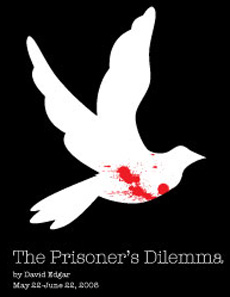
Of course, Theatre Mir is first and foremost a theatre company, and the lectures, panels and talkbacks will matter only if the company can put on a good show. In Chambers' words, "If you just lecture about game theory and peace negotiations, you miss the human struggle and conflict. In theatre, you get to see it played out. To actually see the peace negotiation is much more potent." He's right. The Prisoner's Dilemma is play of complicated, abstract ideas spoken by over 40 characters played by 14 actors. Not an easy piece -- but in this production it is indeed "potent."
Theatre Mir has set quite an agenda for itself: global issues, audience engagement, new work, artistic excellence. But coming from people who have been around the block once or twice, this doesn't all sound like hot air, it sounds like plans.
Anne Nicholson Weber
Anne@TheatreInChicago.com
Theatre in Chicago contributor Anne Nicholson Weber saw Jack and the Beanstalk at the Goodman Children’s Theatre and has loved theatre every since. She is the author of Upstaged: Making Theatre in the Media Age, which includes interviews with Tony Kushner, Julie Taymor, Maggie Gyllenhaal, Martha Lavey and Sir Peter Hall, among many others, and her work has been published in American Theatre Magazine and other national publications.