
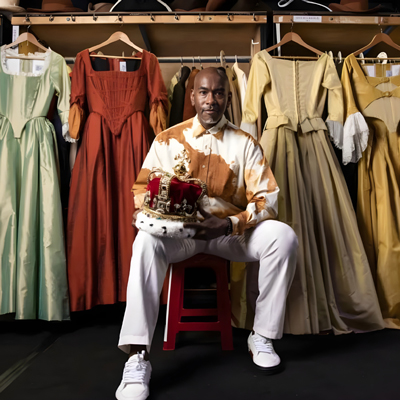
The exhibit is included with general admission to the Griffin Museum of Science and Industry. It runs through September 7, 2026 — giving Chicago theatre lovers plenty of time to experience it, though you'll want to go sooner rather than later.
Who Is Paul Tazewell?
For anyone who has been moved by the visual storytelling in Hamilton, dazzled by the gowns in Wicked, or captivated by the swirling dresses in Steven Spielberg's West Side Story, you already know Paul Tazewell's work — even if you didn't know his name.Tazewell's career spans more than three decades across theatre, film, television, and even ballet. His list of accolades is staggering. He won Tony Awards for his costume designs for both Hamilton and Death Becomes Her on Broadway, earned an Emmy for The Wiz Live!, and in 2025, he made history as the first Black man to win the Academy Award for Best Costume Design for his breathtaking work on the film adaptation of Wicked.
Born and raised in Akron, Ohio, Tazewell's creative path began early. His mother, Barbara, taught him to draw and sew as a child, and he credits her as the spark behind his artistic ambitions. She would craft marionettes and dioramas out of paper, fabric, and everyday objects, bringing characters to life through handmade puppets and scenes — a lesson that clearly left a lasting mark. As Tazewell has reflected, she was the one who taught him to be a problem-solver.
At just sixteen years old, Tazewell designed costumes for his high school production of The Wiz — a full-circle moment, given that he would go on to win an Emmy decades later for The Wiz Live! He was also captivated from a young age by the famous shift from sepia-toned Kansas to vibrant Technicolor in the 1939 film The Wizard of Oz, a cinematic moment that still inspires his approach to color and visual transformation.
What You'll See at the Exhibit
Crafting Character is housed in the museum's Kenneth C. Griffin Studio, and it's far more than a collection of costumes on mannequins. This is a deeply immersive, multimedia experience guided by Tazewell's own narration. As you move through the galleries, his voice walks you through his creative journey, accompanied by behind-the-scenes video, original sketches, family photographs, and projections that bring the walls to life.The exhibition opens with a room dedicated to Tazewell's origins and inspirations. Here you'll find artwork by his mother, costume sketches from his college years, and some of the marionettes from his childhood — including the very first one he made at four years old, a Little Red Riding Hood-inspired doll. Anchoring this space is Janelle Monáe's stunning custom Thom Browne suit from the 2025 Met Gala, which Tazewell co-designed.
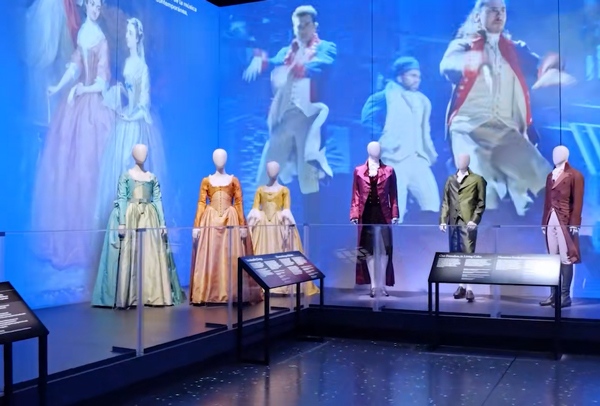 From there, the exhibit takes you through the highlights of Tazewell's remarkable career. Among the standout pieces on display are Glinda's iconic pink bubble dress and Elphaba's Emerald City dress from Wicked, Anita's flowing yellow dress from Spielberg's West Side Story, and an array of costumes from the original Broadway production of Hamilton — including the Schuyler Sisters' Winter Ball gowns, Thomas Jefferson's purple suit, Alexander Hamilton's and Aaron Burr's costumes, and King George III's royal ensemble.
The exhibit also features work from The Wiz Live!, the Death Becomes Her Broadway musical, Pacific Northwest Ballet's The Sleeping Beauty, and the film Harriet.
The Art and Science of Costume Design
One of the most fascinating aspects of this exhibit is how it reveals the engineering and problem-solving behind Tazewell's designs — making the Griffin Museum of Science and Industry a surprisingly perfect home for a costume exhibit.Take Anita's yellow dress from West Side Story, for example. On screen, it appears to ripple effortlessly as Ariana DeBose spins through the "America" sequence. But as the exhibit reveals, countless technical decisions went into achieving that movement. As Tazewell has explained, there is geometry that goes into the pattern making, and specific choices about fabrics and textile fibers that each bring something different to the final result.
Glinda's pink bubble dress from Wicked is another marvel of construction. Made of layered nylon and silk organza, the dress is composed of 137 pattern pieces and approximately 20,000 beads. And for The Sleeping Beauty ballet, Tazewell's costumes were specifically engineered to withstand the physics of dancers running and leaping across the stage, using cutting-edge technology to solve design challenges.
Tazewell himself has spoken about how science is woven into his craft, pointing to 3D printing, digital laser cutting, and the fundamental engineering required to make costumes move in very specific ways. All of that, he has noted, exists within the world of science.
A Room Dedicated to Collaboration
One particularly compelling section of the exhibit spotlights the talented craftspeople who help bring Tazewell's visions to life. Costume design is never a solo endeavor, and Tazewell is deeply intentional about honoring the artisans on his team. As he has said, there are many minds behind creating and realizing a costume, and he has had the privilege of designing alongside incredibly skilled makers.The exhibit highlights collaborators including Miodrag Guberinic, who assisted on the Wicked films, tailor Artur Allakhverdyan, who worked on Hamilton, and Mark Zappone, who collaborated on The Sleeping Beauty ballet.
The Grand Finale: Wicked
The final room of the exhibit is devoted entirely to Tazewell's work on the Wicked film — his most ambitious project to date. He designed more than a thousand pieces for both Wicked movies, with 25 costumes alone for Cynthia Erivo's Elphaba and another 25 for Ariana Grande's Glinda.Here, visitors can see up close how Tazewell used costume to define character. Glinda's effervescent pink bubble dress is not just a beautiful garment — it's a deliberate nod to the original Wizard of Oz and a reflection of an archetype of goodness. Meanwhile, many of Elphaba's dark ensembles feature mushroom-inspired micro pleats and layered textures that speak to her deep connection to nature and animals. Every design choice is intentional, a visual language that communicates who these characters are before they say a word.
Why Theatre Fans Should Not Miss This
Chicago is one of the greatest theatre cities in the world, and this exhibit speaks directly to what makes live performance so magical — the artistry that happens behind the curtain. Seeing Tazewell's costumes up close, understanding the research, sketching, engineering, and collaboration that goes into each piece, gives you a profound new appreciation for what costume designers contribute to storytelling.Tazewell has expressed his hope that the exhibit inspires young people to pursue costume design, or at the very least, that it sparks creativity in everyone who visits. To be that kind of inspiration, he has said, is a big part of why he is here on Earth.
The exhibit also carries special significance in its placement at the Griffin Museum of Science and Industry. It sits adjacent to the museum's 56th annual Black Creativity Juried Art Exhibition, which highlights Black innovators and artists. Tazewell has said he is honored that his exhibit sits alongside that celebration of the artist community in Chicago, and that the exhibit's opening on Martin Luther King Jr. Day was deeply meaningful to him.
As the museum's CEO and President, Dr. Chevy Humphrey, has said, Paul and his work are a shining example of how imagination can become reality, and his personal story offers a spark of inspiration for the next generation of innovators and creators.
Whether you're a devoted theatregoer, a fan of Wicked or Hamilton, a student of design, or simply someone who appreciates the intersection of art and craft, Crafting Character: The Costumes of Paul Tazewell is an experience you do not want to miss.